What Is Jain Astrology, and Do Jains Believe in It? The Honest Guide
By Niket JainPublished Updated Drafted with AI tools under Niket Jain's direction, checked before publishing. How we write
Jain Astrology13 min read
In short
Search for “Jain astrology” online and you will find the same recycled seven-hundred-word article on a dozen portals, usually written by people who practice neither Jainism nor astrology. This page is our attempt at the opposite: a complete, sourced, honest account of what Jain astrology actually is, where it comes from, how it differs from the mainstream Vedic practice, and, just as importantly, what it refuses to do.
For most practicing Jains, the living face of this tradition is the Jain calendar, and it deserves respect for its precision.
Vira Nirvana Samvat, counted from Bhagwan Mahavira’s nirvana in 527 BCE, is the oldest continuously used era in India. The year changes at Kartika Shukla 1, just after Diwali (in 2026 on Tuesday 10 November).
Parva tithis structure each fortnight: Bij, Pancham, Aatham, Agiyaras, and Chaudas, plus Punam and Amas. These are the days of upvas, ayambil, green-vegetable restraint, and pakkhi pratikraman.
Paryushana and Das Lakshana. The Shvetambara Paryushan (eight days, ending in Samvatsari) and the Digambara Das Lakshana (ten days, ending on Ananta Chaturdashi, with Kshamavani two days later) fall at slightly different times and follow different logics. Within traditions there are further honest differences, including the long-standing Ek Tithi / Be Tithi divergence in the Tapa Gaccha.
On all of these, our position is fixed: where traditions differ, we show the traditions side by side and declare none of them wrong. Any Jain astrology resource that crowns one sect’s calendar “correct” has disqualified itself.
This is where Jain astrology diverges most sharply from the astrology marketplace, and where this site draws hard lines.
What the Jain toolkit uses: Navkar Mantra recitation, samayik, fasting on parva tithis, ayambil, swadhyay (study), kshamapana (asking and giving forgiveness), quiet charity and jivdaya, and concrete changes of conduct. Every one of these is free. Every one of these is understood by the tradition itself as karma-shedding.
What we will never recommend:
Animal-derived gemstones. Coral is the skeleton of a marine animal. Pearls are taken from living oysters. Whatever their planetary reputation elsewhere, prescribing them on a Jain site would be a contradiction in terms. (We treat this as applied Jain ethics; you will find community discussion, not a scriptural verse, behind it, and we say so.)
Fire sacrifices and paid ritual packages. Karma is not appeased. It is shed.
Vashikaran, “enemy removal,” occult services. These violate ahimsa and are, besides, frauds.
Fear itself. No death predictions, no “this dosha will destroy you unless.” A hard dasha is karmic weather. Weather is survived with preparation, not with panic purchases.
What the Tradition Itself Warns About
A Jain astrology site that only sells astrology would be dishonest, so here is the tradition’s own caution. Jain monastic literature is ambivalent about prediction: practicing nimitta for livelihood is listed among faults for ascetics, and cautionary tales exist of monks whose predictions, made carelessly or for show, ended badly. Astrology’s respectability within the tradition was preserved for guidance of householders in practical dharma: timing, calendar, self-understanding, not for fortune-telling as spectacle or commerce.
We take that seriously. It is why readings here are framed as karmic weather reports with practical guidance, why the calendar and muhurta work carries as much weight as chart interpretation, and why we never claim monastic endorsement for what is, and should remain, a householder’s science.
Read the full guide6 more sections: the background, the history and where it comes from
The One-Sentence Answer
Jain astrology uses the same sidereal mathematics as classical Indian Jyotisha, but reads the chart through Jain karma theory: the planets indicate the karma your soul carries; they do not cause anything, and what they indicate can be changed by your own effort.
Do Jains believe in astrology? Yes, in a bounded way. Jain texts include astronomy (such as the Surya Prajnapti) and the science of omens (nimitta), and Jain families use the calendar and muhurta for image consecration, diksha, business and weddings. What Jainism does not accept is that planets cause events. They indicate the karma your soul carries, and your own effort changes it. The remedies follow from that: Navkar Mantra, samayik, fasting on parva tithis, forgiveness and charity, not appeasing a planet. Other questions people ask about Jains, from onion and garlic to Diwali, are answered on Why do Jains…?
That sentence contains the entire difference. Everything below unpacks it.
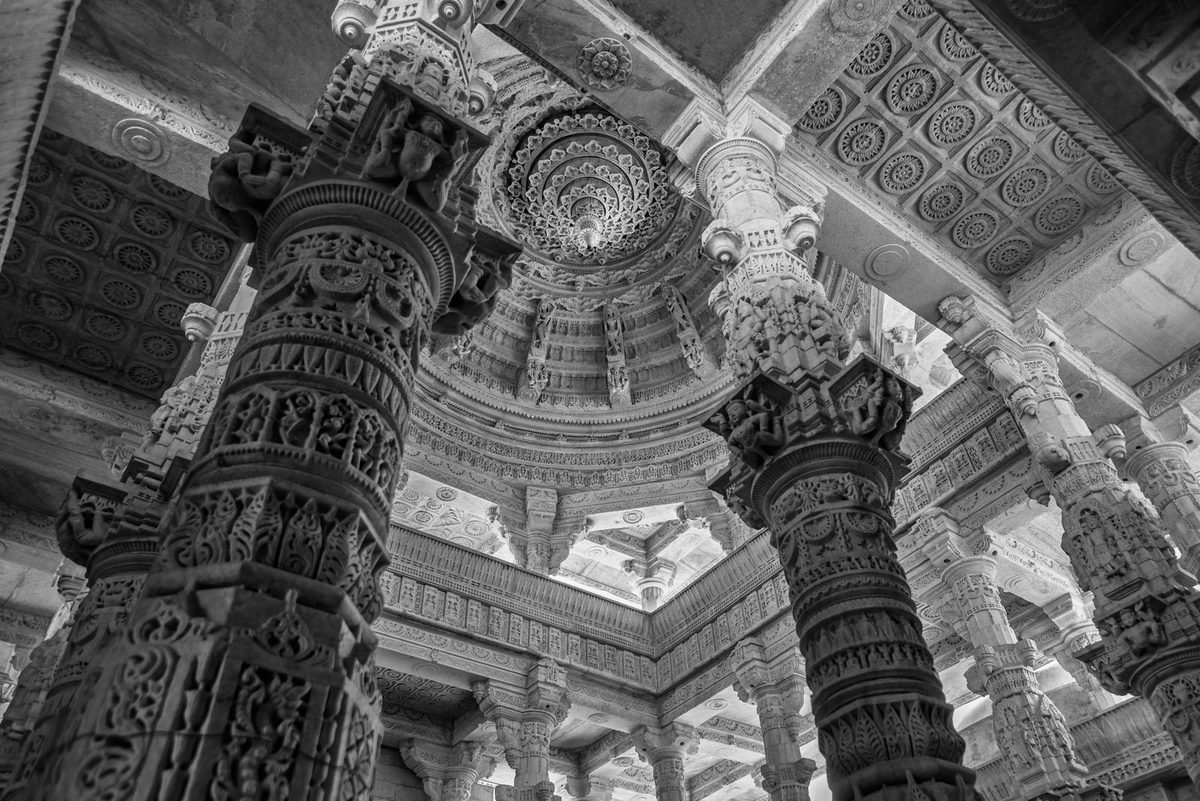
The Ranakpur Jain temple, Rajasthan: 1,444 carved marble pillars, no two alike. Photo: Mustang Joe (CC0), via Wikimedia Commons.
Not a Different Zodiac, a Different Philosophy
Let us clear up the most common misconception first. There is no secret separate Jain zodiac, no different set of planets, no alternative nakshatra list. Practicing Jain astrologers calculate charts exactly as any classical Indian astrologer does: nine grahas, twelve rashis, twenty-seven nakshatras, the dasha systems, the panchang. Anyone who tells you otherwise is selling something.
What is genuinely, deeply different is the interpretive frame:
In much of popular Vedic practice, planets are treated as agents. Shani “punishes.” Rahu “deceives.” A dosha is an affliction to be pacified with a gemstone, a puja, a donation to the astrologer’s preferred cause. The person is a recipient of planetary action.
In the Jain frame, planets are incapable of doing anything to you. Jain doctrine is unambiguous on this point: the soul binds karma through its own activity, and only the soul’s own activity sheds it. The sky at your birth is a reading, not a cause. The chart is a ledger of karma already bound. This is why classical Jain thought classifies astrology among the nimitta-shastras, the sciences of signs. A nimitta points to what is; it does not produce what will be.
This distinction sounds subtle. In practice it changes everything: what a reading is for, what remedies make sense, and whether you leave a consultation afraid or equipped.
The Karma Theory Underneath
Jainism has the most detailed karma theory of any Indian tradition, and it is the engine of Jain astrology.
Karma is substance. In Jain metaphysics, karma is not a cosmic scorekeeper’s ledger entry; it is subtle matter (pudgala) that adheres to the soul through the soul’s own passions and activities. Eight types of karma bind the soul, covering knowledge, perception, feeling, deluding, lifespan, body, status, and obstruction.
Karma is modifiable. Because binding is the soul’s own act, shedding (nirjara) is too: through tapas (austerity), samayik (equanimity practice), pratikraman (repentance), fasting, charity, and right conduct. Jainism is arguably the most effort-centered of all Indian philosophies. Nothing about your chart is a life sentence, because the tradition’s entire path is the deliberate shedding of exactly the karma the chart describes.
Five factors, not one. The doctrine of panch samavaya holds that every outcome arises from five factors operating together: kala (time), swabhava (intrinsic nature), niyati (destiny), purva-karma (past karma), and purushartha (self-effort). Astrology reads, at best, some of the first four. The fifth is entirely yours, and the tradition insists it is decisive. This is the doctrinal basis for our tagline: the chart is the karmic ledger; your effort writes the next entry.
The Textual Lineage
Jain astrology does not need borrowed authority. Its astronomical and prognostic literature is ancient, and some of it is canonical.
Surya Prajnapti and Chandra Prajnapti. Upanga Agamas of the Shvetambara canon, devoted to the motions of the sun and moon: among the oldest systematic astronomical texts in India. They describe the Jain cosmographic model of Jambudvipa, in which two suns and two moons alternate over the continent, a model scholars note predates Greek influence on Indian astronomy. We present this as sacred cosmography, part of the tradition’s self-understanding, not as a claim of empirical astronomy, and a serious Jain site should be honest about that distinction.
Jyotisha Karandaka. A Prakirnaka text on time-measurement: tithi calculation, intercalary months, nakshatras, muhurta. The mathematics of the Jain calendar that still governs festival dates today descends from this literature.
The nimitta tradition of Acharya Bhadrabahu. Bhadrabahu, the last Shruta-kevali, is the tradition’s great name in ashtanga nimitta, the eightfold science of signs, and tradition credits him with foreseeing the twelve-year famine that split the sangha’s history. The Bhadrabahu Samhita, the omen-lore compendium bearing his name, survives in later compilations; scholars date the extant text centuries after his life. We cite it as an attributed tradition, not as his verbatim work, because this community deserves honesty over embellishment.
Mahaviracharya’s Ganita Sara Samgraha (c. 850 CE). Written by a Digambara acharya, it is the earliest surviving Indian text devoted purely to mathematics, and its author is credited with separating mathematics from astrology as disciplines. The Jain intellectual tradition did not merely use the exact sciences; it built them.
And one beloved legend, labeled as such: medieval story-collections tell of Varahamihira and Bhadrabahu as rival brothers. They lived roughly nine centuries apart. We tell the story as a story. Any site that presents it as history should make you doubt everything else it says.
What Jains Actually Use Astrology For
The tradition’s own center of gravity is not fortune-telling. It is timing: muhurta.
Pratishtha muhurta. The consecration of a Jina image (Panch Kalyanaka Pratishtha Mahotsava) is timed with great care: tithi, nakshatra, auspicious yogas, avoidance of combust planets. Digambara manuals such as the Pratishtha Pradip codify the requirements.
Diksha muhurta. The timing of monastic initiation, one of the most consequential events in Jain life, is traditionally chosen astrologically. Classical muhurta compendia in the Jain tradition, such as the Muhurtraj, treat diksha timing at length.
Business muhurta. The Jain trading community runs on the calendar: Chopda Pujan (blessing the new account books at Diwali), Labh Pancham (kept by many Jains as Gyan Panchami, the day of knowledge), Guru Pushya days for major purchases, and daily choghadiya for ordinary decisions. Our Jain Panchang computes choghadiya for any city in the world.
Marriage matching. Jain families use the standard 36-guna Ashtakoota system, read alongside community considerations. Our matching tool provides the calculation; a consultation provides the honest context that raw scores never carry. See how Jain families choose a wedding date.
Namkaran. Naming a child by the syllable of the birth nakshatra is common practice, and Jain families often choose from the names of Tirthankaras, satis, and virtue-names.
Tirthankaras and the Nine Grahas
The tradition also records each Tirthankara’s own birth star: we have compiled the complete, source-verified table of all 24 janma nakshatras and rashis, cross-checked between the Shvetambara and Digambara textual lines, on its own page: The Birth Stars of the 24 Tirthankaras.
A widely followed modern devotional practice associates each graha with a Tirthankara, and turns to darshan, bhakti, and mantra of that Jina, rather than planet-propitiation, when a graha’s period is difficult:
Graha
Tirthankara (traditional association)
Surya (Sun)
Padmaprabha Swami
Chandra (Moon)
Chandraprabha Swami
Mangal (Mars)
Vasupujya Swami
Budh (Mercury)
Vimalanatha Swami
Guru (Jupiter)
Rishabhanatha (Adinatha)
Shukra (Venus)
Suvidhinatha (Pushpadanta) Swami
Shani (Saturn)
Munisuvrata Swami
Rahu
Neminatha Swami
Ketu
Mallinatha Swami / Parshvanatha Swami
Two honest notes. First, this mapping is traditional practice, not canon: variant lists exist (Parshvanatha is given for Rahu or Ketu in different sources), and we document the variants rather than hiding them. Second, the theology matters: a Tirthankara is not petitioned for favors. The practice is understood as bhakti that purifies the devotee, aligning perfectly with the Jain view that it is your own transformed conduct, not an appeased planet, that changes outcomes.
The stotra literature extends this remedial toolkit: the Bhaktamar Stotra, whose verses carry traditional uses for specific difficulties and fears (a per-verse healing tradition documented from the 14th-century commentary onward, greatly elaborated in the modern era); the Uvasaggaharam Stotra, attributed to Bhadrabahu himself, recited for the removal of obstacles; and above all the Navkar Mantra, the universal remedy of the tradition, honored by every sect without exception. One honest note: for planet-specific shanti the tradition uses a separate Navagraha Shanti Stotra, not the Bhaktamar; we keep those layers distinct.
Four of the grahas have a Jain reading through all 27 nakshatras on this site, on one page that links to every full reading: Saturn, Venus, Mercury and Ketu.
Frequently Asked Questions
↳ Is Jain astrology a completely different system from Vedic astrology?
No. The calculation is the same sidereal Jyotisha used across Indian astrology. What differs is the philosophy (karma as modifiable substance, planets as indicators rather than agents), the textual lineage (Surya Prajnapti, the nimitta tradition), the calendar (Vira Nirvana Samvat, parva tithis), and the remedial toolkit (ahimsa-compliant practices instead of gemstones and fire rituals).
↳ Do Jains believe in astrology?
Yes, in a bounded way. Jain texts include astronomy and nimitta, the science of omens, and Jain families use the calendar and muhurta for image consecration, diksha, business and weddings. What the tradition rejects is the idea that planets cause events or punish people. The chart is read as a picture of karma already bound, which the soul's own effort can change. The tradition also warns ascetics against making prediction a livelihood.
↳ What are the remedies in Jain astrology?
Only practices that shed karma and harm nothing: Navkar Mantra recitation, samayik, fasting on parva tithis, ayambil, swadhyay or study, kshamapana (asking and giving forgiveness), quiet charity and jivdaya, and real changes of conduct. Stotras such as the Bhaktamar and the Uvasaggaharam are recited for obstacles. All of these are free. This site does not recommend animal-derived gemstones such as coral and pearl, fire sacrifices, paid ritual packages or anything sold through fear.
↳ Do Jains believe planets affect their lives?
The doctrinally careful answer: planets indicate, they do not cause. The chart at birth reflects karma already bound by the soul. Difficult planetary periods correspond to the fruition of difficult karma, and the tradition's response is effort: tapas, restraint, forgiveness, charity, not planetary appeasement.
↳ Can non-Jains use Jain astrology?
Of course. Anyone who prefers an astrology of effort over an astrology of fear will find the Jain frame liberating. The mathematics is universal; the honesty is the point.
↳ Why do Shvetambara and Digambara festival dates differ, and which is right?
The two traditions count the sacred days differently: Shvetambara Paryushan is eight days ending in Samvatsari; Digambara Das Lakshana is ten days ending on Ananta Chaturdashi, with Kshamavani two days later, and tithi-observance rules (especially for lost and doubled tithis) differ further by gaccha. Neither is "right." Both are old, internally consistent, and followed in good faith. Follow your own sangh, and extend Uttam Kshama to those who follow another.
↳ What should I actually do in a difficult Shani period?
The Jain answer: nothing you must pay for. Take up upvas or ekasana on Aatham and Chaudas if your health allows, and speak to a doctor first if you take regular medicine, are pregnant or have a condition affected by fasting. Recite the Navkar Mantra daily. Practice kshamapana with someone you have been avoiding. Give quietly. Saturn's periods reward exactly what the Jain path prescribes anyway: discipline, humility, and restraint. That convergence is not a coincidence; it is why this tradition and this science fit each other.
This page is a living document. If you find an error of doctrine, date, or attribution, tell us: corrections are a service, and we credit them. For today’s tithi, parva days, and pachkhan times anywhere in the world, see the Jain Panchang. To have your own chart read this way, book a consultation.